
Pillar 3a in Switzerland: Guide to Tied Pension Provision (2026)
In 2026, pillar 3a in Switzerland allows you to deduct up to 7,258 CHF and to make retroactive buybacks for the first time. Much more than just a tax deduction, tied pension is one of the most important levers in the retirement planning.
This independent guide decodes the new 2026 rules, withdrawal optimization, and the crucial trade-off between banking and insurance to protect your capital and your family.
Pillar 3a is a strategy. At Invexa, we advise you independently, with carefully selected banking and insurance partners.
Pillar 3a in a nutshell
- Pillar 3a allows for’save for retirement while enjoying a tax deduction annual.
- 2026 Ceiling: 7,258 CHF for employees affiliated with the 2nd pillar / up to 36,288 CHF (20% of income) for the self-employed.
- Any person practicing a gainful activity subject to OASI, including cross-border workers.
- Withdrawal available between -5 and +5 years of retirement or earlier under certain conditions.
- The withdrawn capital is taxed separately at reduced rate, depending on the canton.
- Column 3a capital is exempt from wealth tax the entire duration of the contract.
- It is recommended to'open between 3 and 5 accounts in order to withdraw them over several years and thus reduce the tax burden,
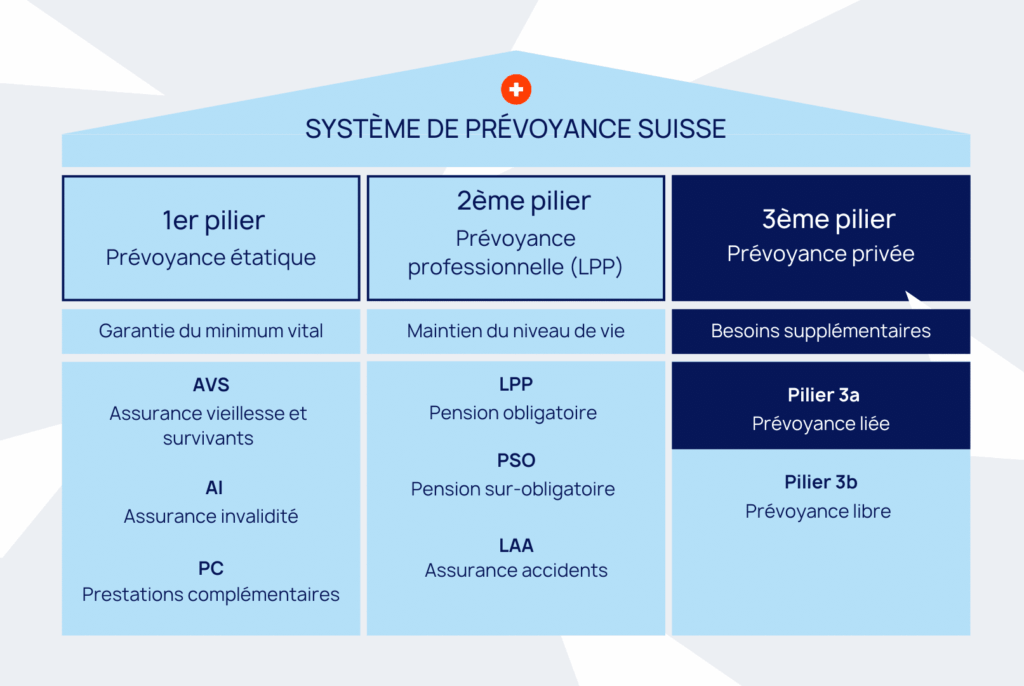
Diagram: The role of Pillar 3a in the Swiss pension system
What is Pillar 3a?
Introduced in 1972 into the Constitution, pillar 3a represents the tied individual provident fund. It is characterized by its advantageous tax framework and its main purpose is preparing for retirement.
This private contingency plan represents a voluntary savings which complements the first two pillars (OASI and pension fund) you Swiss pension system and who, in exchange for tax deductions, has withdrawal restrictions. The accumulated funds can only be accessed in the event of retirement, disability, death, or for the purchase of a first home, under certain conditions.
Pillar 3a: advantages and disadvantages
Benefits of Pillar 3a
- Tax deductions on taxable income
- Reduction of federal, cantonal, and communal taxes
- Important supplement to retirement (1st and 2nd pillar)
- Attractive return via investment funds
- Reduced Tax Liability Upon Withdrawal
Disadvantages
- Funds Locked Up Until Retirement (with Limited Exceptions)
- Annual contribution cap
- Limited flexibility
- Tax Due Upon Withdrawal of Capital
How much can I contribute to my pillar 3a in 2026?
In 2026, it is possible to pay the following amounts in tied private pension provision:
- Employee affiliated to a pension fund: Up to CHF 7,258 / year
- Self-employed or employee not affiliated to a pension fund: 20% of income, up to a maximum of CHF 36,288
Who can open a tied pension account?
Any gainfully employed person subject to OASI in Switzerland can open a pillar 3a. This includes employees, the self-employed, unemployment benefit recipients, and cross-border commuters.
What are the tax advantages of pillar 3a?
The contributions paid are deductible from taxable income at the federal level, which reduces annual taxation.
Furthermore, during the contract, no wealth tax will be levied, which allows the capital to grow without additional costs.
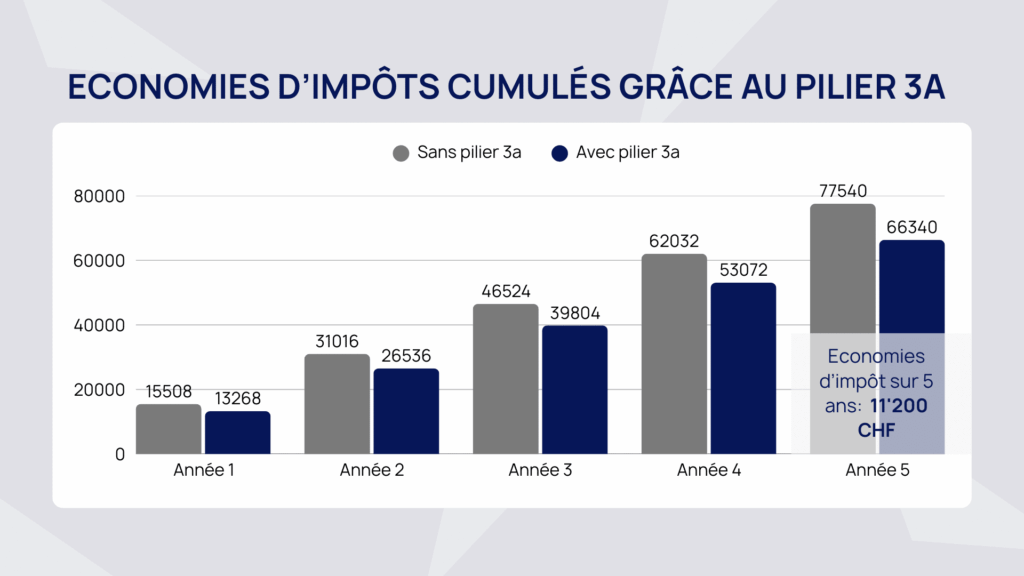
Chart: Cumulative tax savings through contributions to pillar 3a
Over the course of a year, you could potentially save 2,240 CHF in taxes. Over five years, that would represent approximately CHF 11,200 taxes saved.
Scenario: Single resident in Geneva earning a gross income of CHF 100,000.
How to calculate the tax deduction in pillar 3a?
To calculate the tax deduction you’ll receive, you’ll need to know your marginal tax rate. Let’s take this example:
- Canton: Geneva (GE)
- Municipality: Geneva (1205)
- Number of dependent children: 2
- 1. Net annual income: 90,000 CHF
- 2. 3a Contribution: –7,258 CHF
- 3. Other tax deductions (flat-rate): -52,594 CHF
- 4. Taxable income: approx. 70,500 CHF
- 5. Taxable income: Cantonal rate: 148.5 %
- 6. Municipal tax rate (City of Geneva): 45.5 %
- 7. Total: 194 %
After applying these rates and the canton's progressive tax scale, the result is:
- 8. Total taxes with 3a: 1,692 CHF
- 9. Total taxes without 3a: 3,049 CHF
- In other words, by contributing CHF 7,258 to your pillar 3a, you could reduce your taxes by approximately 1,350 CHF per year in Geneva.
- This represents nearly 19 % in Economics on your payment.
Choose between a bank or insurance pillar 3a
There are a multitude of possibilities in the pillar 3a. First, a distinction is made between two main categories: the Pillar 3a with a bank and Pillar 3a with an insurance company.
| Criteria | 3A Insurance | 3A Bank |
|---|---|---|
| Payment frequency | Determined in advance | Flexible |
| Investment type | Classic (simple savings), Mixed (savings/investment), up to 100 % funds | Classic (simple savings), up to 100 % funds |
| Surpluses | Profit participation | No share of surplus |
| Possible coverage | Death cases, disability cases | None |
| Bankruptcy Protection | Guaranteed amount at 100 % | Amount guaranteed up to CHF 100,000 |
| Waiver of Premiums in the Event of Total and Permanent Disability | Possible | None |
| Investment Horizon | Medium- to long-term only | Short-term (account), medium- to long-term (fund) |
| Guaranteed capital share | Possible | None |
| Pledge | Possible | Possible |
| Key Benefits | Insurance coverage, savings continuity in the event of disability, surplus participation, guaranteed amounts | Higher surrender value, better short-term return after fee deduction, payment flexibility |
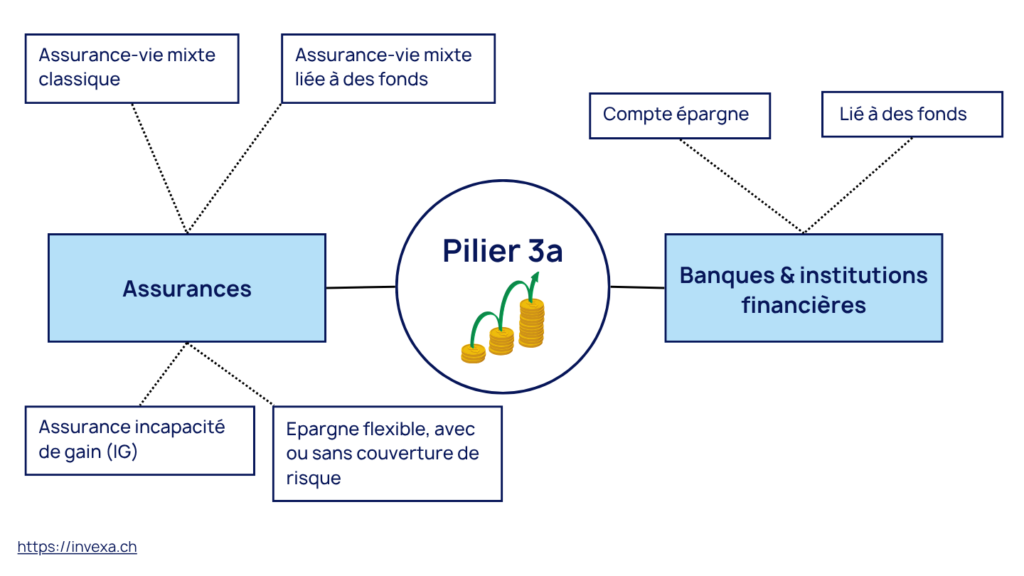
Diagram: Investment Options in Banks and Insurance Companies Under Pillar 3a
Fees: Insurance vs. Bank
A good fund-linked 3a insurance is most of the time cheaper than a long-term Pillar 3a bank account. With insurance, however, fees are deducted at the start of the policy. This is something to keep in mind if you wish to make an early withdrawal.
Withdrawal from a 3a account: Conditions for early withdrawal
The Conditions for early withdrawal of pillar 3a are strictly regulated to ensure that the savings remain dedicated to providence and retirement. Here is a breakdown of the various situations in which an early withdrawal, whether partial or total, is possible:
1. Retirement Age
Old-age benefits can be paid at the earliest 5 years before the insured reaches the standard OASI retirement age («reference age») and at the latest five years thereafter.
2. Buyback of 2nd-pillar contributions
An early withdrawal is permitted when the Pillar 3a savings are used to pay back contributions in a 2nd-pillar pension fund. This option allows you to supplement or adjust your occupational pension savings in the event of gaps.
3. Upon receipt of a full DI pension
If the pension plan participant is entitled to a full disability pension from the AI and the risk of disability is not covered by the pension plan, the early payout may be activated.
4. Change in Self-Employment
An early withdrawal is also an option for a pension plan participant who changes to self-employment. This provides the necessary liquidity to support their career transition.
5. Launching an independent business
If the pension plan participant moves to his or her own account, early withdrawal can be requested. The objective is to provide financial support when starting an independent or entrepreneurial activity, which is often crucial in the initial phases of business creation.
6. Permanent departure from Switzerland
If the pension policyholder leaves Switzerland permanently, he may proceed with an early withdrawal of his funds. This provision is intended to allow the policyholder to access their savings when moving abroad.
7. Acquisition of a home or repayment of a mortgage loan
Early withdrawal is also possible when the funds are used to acquire residential property for one's own needs or to repay mortgage loans. This condition facilitates homeownership by allowing policyholders to use their savings in a tangible way as part of a real estate project.
Tax upon withdrawal
The withdrawal of a tied pension plan (3a) in Switzerland is subject to a single tax on lump-sum benefits (just like the’withdrawal tax on the 2nd pillar), which is withheld separately from ordinary income at a reduced rate. This tax varies by canton, municipality, and the amount withdrawn. A 3a account must always be withdrawn in full.
How does it work?
- Separate taxation: The withdrawn capital is not added to the salary for the year, but is taxed according to the specific scale for pension benefits.
- Reduced rate: Direct federal tax is calculated at approximately one-fifth (20 %) of the standard rate in most cantons. The cantons also apply lower preferential and progressive tax brackets.
- Total withdrawals: Withdrawals made in the same year (from other 3a accounts or the second pillar) are added together to calculate the progressive tax rate.
How to reduce the tax burden?
- Stagger the withdrawals: Open multiple Pillar 3a accounts over the years and withdraw them in different years (from 5 years before OASI age, or up to 5 years after if you are still working).
- A word of caution for spouses: Coordinate withdrawals if you are married, as the amounts received in the same year are added together in most cantons.
How many pillar 3a accounts can I hold?
There does not exist no legal limit As for the number of 3a accounts you can hold, in practice, you can open several accounts—for example, a bank account and a life insurance policy.
However, there is still a single annual contribution limit, which applies to the total of all your contributions, meaning that the total amount deposited cannot exceed the limit set by law.
Optimize your Pillar 3a
Inheritance and Beneficiary Clause
- 1. The surviving spouse or the registered partner,
- 2. The direct descendants, a person who had been living with the decedent as a common-law spouse for at least five years, or a person whom the decedent substantially supported,
- 3. Parents,
- 4. Brothers and sisters,
- 5. the other legal heirs.
The insured person may, however, refine this hierarchy to a certain extent. For example, he can choose and distribute freely the shares between the persons listed under number 2 (children, partner, dependents). Likewise, he/she can change the order between categories 3 and 5.
On the other hand, the spouse or surviving registered partner remains Priority until the law has changed. Note that Parliament and the Federal Council are currently examining a reform of Pillar 3a that should offer more flexibility in the designation of beneficiaries starting in 2027, notably the possibility of favoring children even in the presence of a spouse.
Becoming a homeowner through pillar 3a
Early withdrawal (EPL)
Withdrawal under the’Housing Ownership Incentive (EPL) allows you to withdraw all or part of your 3a savings to finance your primary residence.
- Advantages: You are increasing your down payment, which reduces the amount of your mortgage debt and, as a result, your monthly interest payments.
- Disadvantages: The withdrawn funds are immediately subject to pension withdrawal tax (at a reduced rate, separate from your other income). In addition, you reduce your retirement pension coverage.
- Golden rule: You can make a withdrawal once every 5 years.
Pledging (Security Interest)
The Pledging of 3rd-pillar assets involves using your contract as guarantee with the bank, without withdrawing the money.
- Advantages: Your capital continues to grow and generate interest (or investment fund returns). Most importantly, you avoid the immediate taxation associated with a withdrawal. This often allows you to maintain a higher level of debt, which is paradoxically advantageous for the tax deduction of interest expense on your tax return.
- Disadvantages: Your monthly mortgage payments will be higher because the debt is not repaid using the 3a principal.
- Utility: This is the preferred option for those whose investment returns exceed their mortgage interest rate.
Which solution should we choose in 2026?
The choice depends mainly on current mortgage rates and your tax burden. If rates are low, the pledge is often mathematically superior. If you want to minimize your monthly expenses as much as possible, the withdrawal is more appropriate.
- It is also possible to combine the two approaches. For example, you could withdraw a portion of the funds to reach the 20% equity requirement and use the remainder as collateral to ensure the indirect repayment of your loan.
Pillar 3a Buyback: How Can You Make Up for Contribution Shortfalls Starting in 2026?
Starting in 2025, Pillar 3a allows you to make up for unpaid contributions from previous years, offering an opportunity for tax optimization and retirement planning.
The first redemptions will be possible as early as 2026 to fill the gaps in 2025, with a maximum retroactive effect of 10 years. The maximum annual redemption amount is 7,258 CHF (employees and self-employed individuals), fully deductible from taxable income.
The requirements include having income subject to AVS and paying the full annual contribution. This measure complements the options for transferring funds to the second pillar and serves as a strategic tool for increasing retirement savings while reducing taxes.
Pillar 3a vs. 3b: Which One Should You Choose?
There are two variants in the 3rd pillar (private pension). Pillar 3a is a linked retirement savings, offering significant tax deductions. The funds are locked in and can only be withdrawn in the event of specific circumstances (retirement, purchase of a home, disability, permanent departure from Switzerland).
The Pillar 3b, also called voluntary retirement savings, on the other hand, is a additional savings more flexible, without the constraint of strict usage. Although it benefits from fewer tax advantages when taken out as insurance, it allows free access to funds for various projects. In short, doing the difference between a 3a and a 3b relies mainly on flexibility as well as tax deductions to be exploited.
Compare pillar 3a solutions
Special cases: withholding tax
Contrary to popular belief, pillar 3a is not reserved for C permit holders or Swiss citizens. However, for persons taxed at source (B or L permits or cross-border commuters), the’tax advantage is not automatic and requires a proactive approach.
Holders of a Class B license (residents)
If you are subject to withholding tax and earn less than CHF 120,000 per year, your 3a deductions are not included in your monthly tax bracket.
The solution: You must apply for a Subsequent Ordinary Tax Assessment (TOU) by March 31 of the following year.
Cross-Border Workers
For cross-border commuters, pillar 3a remains an excellent provident tool, but its tax advantage depends on your status as a quasi-resident (Geneva).
- Quasi-resident status: If at least 90% of your worldwide income comes from Switzerland, you can apply for the TOU and deduct the full amount of your 3a contributions
- Non-quasi-resident: If you do not meet this 90% requirement (for example, if your spouse works in France and earns a high income), contributions to a Pillar 3a account will not be tax-deductible in Switzerland. In this case, the interest is purely for asset-building purposes and has no tax benefits.
Don't forget that it is now possible to make retroactive contributions to fill in contribution gaps from previous years (subject to certain conditions). This option is also available to «sourciers» through the TOU procedure.
Which Pillar 3a plan should you choose based on your situation?
Choosing the best 3a pillar plan in Switzerland depends on your profile, your age, and your retirement planning needs. To help you quickly identify which option best suits your situation, we’ve created a comprehensive matrix followed by detailed explanations for each profile.
| Profile | Recommended Solution | Coverage to Include | Priority |
|---|---|---|---|
| Single employee < 40 years old | 3a Insurance + 3a Bank (funds) | Inability to Earn Due to Illness | Protection + Performance |
| Family with children | Priority 3a Insurance + 3a Bank (funds or guaranteed principal) | Death + Disability Due to Illness | Family Protection |
| Self-employed without pension fund | 3a Insurance (Funds) | Death + Disability Due to Illness or Accident | Protection + Taxation |
| Cross-border worker (quasi-resident) | 3a Bank (funds or interest-bearing accounts based on investment horizon) | Impossible in Switzerland | Flexibility + Taxation |
| Nearing retirement < 10 years | 3a Bank only (interest-bearing account or small % stock portfolio) | Too expensive | Capital preservation |
In practice, there is no one-size-fits-all solution when it comes to pillar 3a. The choice depends mainly on’age, of family situation, you professional status and the’investment horizon. Combining several banking and insurance solutions often makes it possible to optimize flexibility, protection, and tax advantages at the same time.
A personalized analysis remains essential in order to adapt the provident strategy to real needs and to avoid inappropriate decisions in the long term.
Calculate Your Return Potential
Discover what you could potentially save by your retirement with a 3a solution.
Past or simulated performance is no guarantee of future performance. This projection is given for guidance purposes only.
Get Expert Advice
Opening a pillar 3a is an important decision that deserves thorough analysis. It is essential to define your profile and you needs before selecting and comparing the different available solutions. The fees and conditions can indeed vary considerably from one provider to another, which can have a significant impact on your long-term returns.
2026 Checklist: 5 steps to open your 3a pillar
- Check your eligibility for AVS: Make sure you have income subject to AVS in 2026. If you are a cross-border worker, check whether you or your household meets the 90% threshold for Swiss income to qualify for the tax deduction (quasi-residence).
- Conduct a "Banking and/or Insurance" audit: Don't just go with the default option. Check whether you need a simple savings plan or if your situation requires coverage in case of disability or death. Combining the two is often the smartest solution.
- Plan Your Gap Coverage Buybacks (New for 2026): This is the pivotal year to make up for your missing years. Calculate the optimal buyback amount to maximize your tax savings without exceeding your cash flow capacity.
- Optimize Splitting (Multiple Accounts): To avoid massive taxation upon withdrawal, it is crucial to open multiple 3a accounts. We plan the withdrawal dates staggered over 5 years together to reduce tax progression.
- Automate your payment: Don't make the entire payment on December 31. Set up a standing order (e.g., 604.85 CHF per month to reach the 7,258 CHF limit). This allows you to average your entry price in the markets if you're investing in funds.
Frequently Asked Questions
What is Pillar 3a?
Pillar 3a is a type of tied individual provident fund in Switzerland. It allows you to save for retirement while enjoying tax benefits. It is subject to strict conditions regarding beneficiaries, contribution amounts, and withdrawal options.
Who can contribute to pillar 3a?
Anyone who is gainfully employed in Switzerland and pays contributions to the OASI can contribute to pillar 3a. This includes:
- Employees,
- Cross-border workers,
- The freelancers,
- Unemployed individuals who meet certain conditions.
What is pillar 3a used for?
Pillar 3a allows you to:
- To supplement AVS and LPP pensions,
- To protect yourself against the risks of disability and death
- To reduce one's taxable income (thanks to the tax deduction),
- To build long-term wealth
- To finance a real estate project or a transition to self-employment.
Is Pillar 3a taxed upon withdrawal?
Yes, but at a reduced rate of about 1/5 of the tax rate, separately from the rest of the income.
Until when can I make my 3a contribution?
Who contributes to the second pillar?
Every employee aged 17 or older whose annual income exceeds CHF 22,680 (in 2026). The self-employed can join voluntarily.
How to withdraw your 2nd pillar in Switzerland?
You can unlock your 2nd pillar in Switzerland at retirement, or earlier to buy a home, become self-employed, or permanently leave the country.
Claire Fivaz
Ask for Advice on Pillar 3a
Schedule an appointment Schedule a no-obligation consultation with our experts to discover the solutions 3a, analyze your needs, and objectively compare the best options on the market.
Everything About Pillar 3a
To go further, discover our articles on pillar 3a, written by our experts.