
 EN
ENPrivate retirement provision in Switzerland (3rd pillar) is the most effective way to secure your standard of living in retirement while immediately reducing your taxes.
Whether you're after the tax deductibility of Pillar 3a (2026 ceiling: CHF 7,258 for employees, CHF 36,288 for the self-employed) or the flexibility of Pillar 3b, this comprehensive guide brings together our comparisons, tax savings calculators, and expert advice to help you choose the best solution.
Your retirement provision deserves a tailored approach, not a generic product. At Invexa, we guide you with complete independence through the best Pillar 3a/3b solutions on the market, carefully selected from our banking and insurance partners.
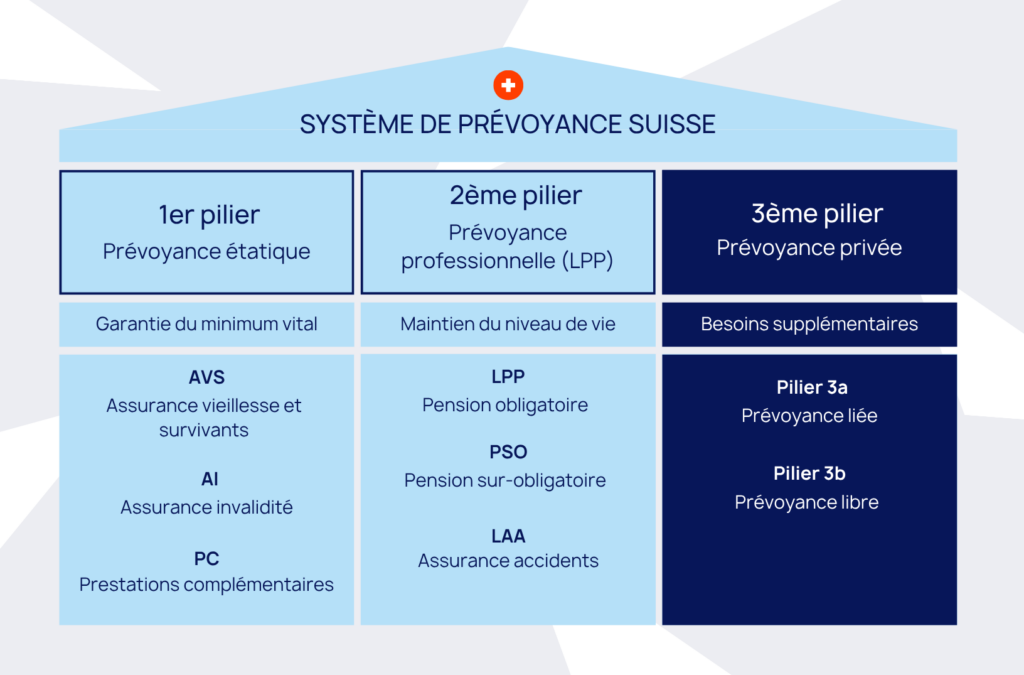
Diagram: The Role of the Third Pillar in the Swiss Pension System
How much will your 3rd pillar have earned by the time you stop working?
With our simulator, you can estimate the final value of your savings (3a or 3b) at retirement age in just a few clicks. Discover the powerful impact of compound interest over the years and compare the results between a traditional bank account and an investment in equity funds.
Past or simulated performance is no guarantee of future performance. This projection is given for guidance purposes only.
Pillar 3a is voluntary retirement savings with tax advantages, but the money is largely locked away until retirement. Pillar 3b is more flexible private savings, with no limit and no specific tax advantage, usable at any time for various projects.
| Criterion | Pillar 3a (tied): | Pillar 3b (unrestricted): |
|---|---|---|
| Main purpose | Retirement savings with tax optimization | Free savings, flexible and complementary retirement planning |
| Access | Active persons affiliated to the OAS | Open to all (employees, the self-employed, the inactive, retirees) |
| Tax advantage | Deductible from taxable income
| Not deductible (except life insurance in Geneva and Fribourg) |
| Contribution limit | Yes: annual caps set each year | No: open amounts |
| Withdrawal Conditions | Limited to certain cases: retirement, housing purchase, independence, leaving Switzerland | Withdrawal possible at any time |
| Retirement age | No earlier than 5 years before the standard retirement age | Anytime |
| Taxation | Upon withdrawal: single reduced-rate tax | During the contract: wealth tax. Exempt contribution if for retirement savings purposes |
| Possible shapes | Bank account, funds, endowment life insurance | Traditional savings, investments, life insurance, annuities, funds, real estate |
| Payment flexibility | Flexible but limited by law | Complete freedom (amount, frequency, possible interruption) |
| Transfer in the event of death | Beneficiaries defined by law, strict order (spouse, children) | Free beneficiaries (per contract or customized beneficiary clause) |
The choice between a pillar 3a and a pillar 3b depends above all on your financial goals and your personal situation.
The Pillar 3a is a tied solution, designed primarily for retirement. It offers substantial tax advantages, since your contributions are deductible from your taxable income — but in exchange, the money stays locked until you meet certain conditions (retirement, buying a home, starting self-employed activity, or permanently leaving Switzerland). This makes it ideal if you want to prepare for retirement in a disciplined way and benefit from substantial tax savings.
In contrast, Pillar 3b is unrestricted savings that isn't subject to the same withdrawal restrictions. You can deposit and withdraw funds whenever you like, which offers greater flexibility for financing other short- or medium-term projects. It's also open to everyone, unlike Pillar 3a, which requires gainful employment. That said, it doesn't offer the same tax advantages as Pillar 3a, except in a few cantons where deductions are available.
In practice, one will first turn to a pillar 3a, and then to a pillar 3b if there is a need to supplement the benefits of pillar 3a or savings. Given that contributions to certain forms of pillar 3b benefit from tax deductions in certain cantons (e.g., Geneva and Fribourg), as well as tax exemption on lump-sum benefits when the provident character is met, it can also be considered as part of an overall tax optimization strategy.
The Pillar 3a is a form of tied individual savings, offering an ideal solution for retirement provision and reducing your taxes. Unlike Pillar 3b, contributions to a Pillar 3a are capped annually by law, but benefit from major tax advantages, since the amounts paid in are fully deductible from your taxable income.
Pillar 3b is a form of unrestricted individual savings, offering much greater flexibility than Pillar 3a. Unlike Pillar 3a, contributions to a Pillar 3b aren't subject to an annual cap, and don't benefit from the same tax advantages, since they're generally not deductible from taxable income, except in certain cantons.
Generally, the approach is to max out Pillar 3a first. Once the ceiling is reached, you can add a Pillar 3b (funds, life insurance, etc.). The choice mainly depends on your time horizon and risk tolerance. The longer your horizon, the more you can invest in equities. The closer you get to withdrawal, the more you should reduce risk — particularly from ten years before the payout date onward.
There is no single “best” universal third-pillar plan, but in general, the following options are recommended:
A young person can aim for a Pillar 3a heavily invested in equities. A family with a mortgage will prefer an insurance-based Pillar 3a with appropriate death coverage. A self-employed person without an LPP maximizes their Pillar 3a first, then supplements it with a Pillar 3b. High earners optimize their taxes by spreading their savings across several Pillar 3a accounts. Very conservative profiles opt for capital-guaranteed solutions.
Pillar 3a/3b insurance products are designed for the long term: fees are charged upfront, which penalizes early withdrawals in the first few years. If the money might be needed in the near future, it's better to avoid insurance products and reduce your exposure to equities.
Setting up an effective individual retirement strategy relies on a precise analysis of your financial, professional, and tax situation. Depending on your goals, the Pillar 3a can be a tax-advantageous solution for preparing for retirement, while Pillar 3b offers greater flexibility and investment freedom. In either case, a personalized assessment is essential to define the strategy best suited to you.
You can terminate a 3a if one of these conditions is met:
The cancellation terms for Pillar 3b are set forth in your contract.
There are a wide variety of options for the third pillar, including banking or insurance. Most products are available under both the tied pension plan and the voluntary pension plan.
In the insurance sector, a third pillar is often established in the form of a fund-linked or guaranteed-rate life insurance or disability income insurance policy, whereas in the banking sector, a 3a or 3b account is usually a traditional savings account or a fund-linked savings account.
Comparing 3rd pillar options will help you choose the solution best suited to your profile and goals.
People who work in Switzerland—whether you're an employee or self-employed—who generate a income subject to AVS can open a Pillar 3a account. The 3a is available, in particular, to cross-border workers.
Yes, it's possible to transfer your 3rd pillar, whether from one bank to another or from an insurance company to another Pillar 3a solution.
For Pillar 3b, the transfer terms also depend on your contract, but generally speaking, transfers must pass through your private account.
As early as possible. The younger you start, the more you benefit from compound interest and the tax effect. You pay Pay less in taxes by contributing the maximum amount You can only claim it if you don't make any contributions. The higher your marginal tax rate, the more beneficial the deduction is.
Yes. You can open as many 3a accounts as you want. It is even strategically smart during withdrawal because it allows you to spread out the taxation.
Discover our articles on private pensions (3rd pillar), written by our experts.
Reduce your taxes while maximizing your future capital. Our independent experts help you choose the best 3a/3b strategy with no obligation.


 CHF 7,258/year with 2nd pillar